
Du har väl inte missat att Idéburen Utveckling driver ett Erasmus+ Small-scale Partnership-projekt tillsammans med folkbildningsorganisationen Dock Europe i Hamburg?!
I början av oktober var det dags för det tredje och sista studiebesöket inom Erasmusprojektet Shared City Shared Future. Denna gången i Hamburg där en stor grupp från fyra olika föreningar i Malmö togs emot av Idéburen utvecklings samarbetspartner i projektet, Dock Europe.
OBS – den här reserapporten är i engelska eftersom det är ett internationellt projekt där projektspråket är engelska.

The urban is defined as the place where people step on each other’s toes, find themselves before and amidst a heap of objects, where they intersect and intersect again until they have lost the thread of their own activity, confusing situations with each other to such an extent that unforeseen situations arise.
Henri Lefebvre
About the Shared City Shared Future Project
This Erasmus+ Small Partnerships project is an exchange and learning programme between Kirseberg in Malmö and Altona in Hamburg. It is led by the non-formal education platforms Idéburen Utveckling and dock europe e.V. Both organisations work with hands-on processes of civic self-organisation in response to pressing local issues and community-led urban development, with an emphasis on young people’s leadership. The programme invites young leaders, youth workers, and young activists to exchange and share their working practices, ideas, tips, and tools on how to build movements, create events, co-produce physical common spaces, strengthen democratic participation, and support others to feel included. It includes study visits to Malmö and Hamburg with workshops, case studies, and social networking opportunities, as well as a series of online sessions to share methodologies and learnings rooted in local processes.
About the Study Visit
Throughout the project the team from Malmö has grown substantially with young leaders and activists joining from different Malmö based self-organising young initiatives that claim their space in the urban landscape, may it be through sports, street dance, solidarity initiatives and direct action.
Allt åt alla: An activist group, sometimes also calling themselves a social union that is active in several parts of Sweden. In Malmö, they organise around social issues such as housing, social equality, and transport.
Gr8t Ones: A youth-led cultural association focused on street dance and hip-hop. They arrange dance battles, concerts, and mentoring programmes, among other activities.
Bulltofta IF: A sports club in Kirseberg, by and for young people. They train and promote young leaders and work to ensure equal access to sports and leisure activities. The club has 1,000 members and 50 leaders.
I Goda Äpplens Lag: An artisan apple press that uses food waste to make wonderful apple juice and other related products.
Backa Kåken: An association that aims to buy the old prison in Kirseberg and collectively own it to create a place for culture, social initiatives, associations, and much more. Young initiatives, such as Gre8t Ones and I Goda Äpplens Lag are a part of the organising team.
You can find out more about the young organisations and activists that hosted in Altona from this blog.
Themes and focus of this visit
Following reflections on the encounters in Malmö and the local processes run in both Kirseberg and Altona, Dock Europe prepared a programme of activities and workshops to engage with some of the key themes and questions brought to the table by participants.
- The right to the city: What does that mean for us as young people? How do we take space?
- Power gaps and power relations in our organisations and in the work we do in or with communities.
- How do we self-organise and how do we create the conditions so others can join and take the lead: tips and tools.
- Flat, democratic organisations if you want to manage an entire building: decision-making mechanisms, conflict resolution, how to keep each other motivated?
- Visiting others and seeing/experiencing how they work. Doing/making stuff together!
- Networking and collaboration beyond national borders: What is good about working together internationally? What do we want to do more of and with whom?
More about the Right to the City
The idea of Right to the City comes from the French philosopher Henri Lefebvre in the late 1960s. He (and many thinkers and practitioners after him) argued that cities shouldn’t just be built for profit, but for the people who live in them. The concept is about having not only access to urban spaces – housing, parks, culture, transport – but also the power to shape how the city develops.
Right to the City movements exist all over the world. The strength of the idea lies in how it can unite people from different walks of life to fight for cities that are fair, inclusive, and shaped by those who live in them. But of course, as in any other movement, social justice questions of who is at the table, whose voices are heard, and who makes the decisions are ongoing challenges that shape how inclusive the movement truly is.
Friday, October 3rd 7:00 AM
The journey began early in the morning at Malmö Central Station. Energy and spirits were high despite the early hour, and everyone was eager to head to Hamburg!
2:30 PM

After a minor delay, we arrived at fux eG and Dock Europe. We were warmly welcomed by Petra Barz and Suna Voss, who had prepared lunch and handed out the keys to our rooms at Dock Europe’s own hostel.
3:30 PM
We gathered in Dock Europe’s seminar room for introductions and icebreakers — including choosing a postcard featuring a lama (!) to represent ourselves in some way.


We also did an exercise answering three questions:
One wish for this visit. One hope in general. One gift that you contribute to this group
Here are some examples of responses:
Wish: gain new perspectives, be inspired, learn decision-making, gather ideas for future projects.
Hope: dialogue, collaboration, showing that young people can lead, creating safe spaces for children, inclusion, equality, community.
Gift: experience, a youth perspective, bad jokes, random facts about Hamburg.
4:30 PM


Time for a city rally to get to know the area around fux eG! We split into two smaller groups, one with Suna and one with Petra. Suna’s group learned about workers’ history, the St. Pauli and Reeperbahn area, and ended their walk by the harbour. Petra’s group saw a bunker converted into climbing walls and music studios, explored the Schanze district, visited Rote Flora — an autonomous cultural centre that has been squatted since the late 1980s — and climbed the roof of the St. Pauli bunker. Each group had a list of tasks to solve and points for reflection and conversation on the way.
7:00 PM

The groups reunited for dinner at an Anatolian restaurant in Altona — a lovely first evening with good food, new connections, and impressions of the city.
Saturday, October, 9:30 AM
We met again after breakfast in the seminar room for a workshop and started by sharing reflections from the day before.


The group that had been to Reeperbahn, had to debrief a bit about the German legislation that legalises prostitution. An interesting discussion arose. The Swedish delegation were intrigued to hear that legalisation also means that women can organise in unions and get health support.
Another interesting discussion arose around the question of Grafitti. In St Pauli, graffiti (and club culture, the right to make noise) is an expression of identity in a neighbourhood that over decades is trying to resist gentrification. In Kirseberg, a neighbourhood that can nearly feel forgotten by urban development, it can feel like a lack of care and even vandalism. This brought us to discussing what exactly gentrification is. The young people from Altona talked about how they couldn’t anymore afford to live in the neighbourhood they grew up in. Backa Kåken representatives talked about how owning some of the places we care about in community ownership can be a way to keep them affordable and accessible. And Bulltofta IF pointed out that in their case ownership is about a sense or a feeling that young people and children have over places and activities in their neighbourhood. We agreed that both ‘spiritual’ and ‘physical’ ownership are important and can support each other!


Others spoke more about, if the city is accessible. For whom? And if the urban environment can be solidarity-based or -inducing. Is this a bench that invites people to rest or even sleep? What if you are homeless in Hamburg, are there services available? We were impressed by the amount of seemingly self-organised public spaces, from self-build playgrounds to social centers and parks. The Hamburg gang pointed out that that perspective is a bit skewed as they naturally wanted to show us the places they love!
Then we did an exercise called a Hope Café, where we introduced our organisations and the way we work to each other. What moves us? Places, feelings, needs, hopes, desires? And what are our [loved] spaces – what do we move there?


What moves us is being together. The heart starts beating in rhythm with the music,
we find a shared rhythm.
Gr8t Ones
11:00 AM


After the workshop, some participants joined a Thai boxing session with Tyger Trimiar Gym – a martial arts club at fux eG that welcomes only FLINTA (Female, Lesbian, Inter, Non-binary, Trans, Agender) participants. Karla, who led the class, explained that the gym’s goal is to create a safe space in contrast to many “macho” martial arts environments. The 45-minute session was energetic, fun and sweaty!


Meanwhile, others joined a guided tour of fux eG focusing on the exhibition denkXmal, which tells the building’s history. Originally a Prussian military barracks and later a police station, fux eG has been trying to transform its authoritarian past into a place of democracy, accessibility, and openness. Carlos from Fux Populi told us the story of Bruno Tesch a young local antifascist who was executed by the Nazis and who alongside his fellow activists is commemorated in local street names, local graffiti and in the name of the local Youth Centre. It was touching and also a bit overwhelming to discuss the oppressive history of Germany sitting in that staircase together. We were reminded and reminded each other of the worrying turn that our society and even governments are taking at the moment. We discussed how spaces like fux or Backa Kåken could be useful to build safe spaces and resistance. The question came up if fux does an active engagement programme for general publics and specifically for young people and minorities. Petra, Suna and the Fux Populi crew described that they try to do this by making sure the organisations renting in the space are as diverse as possible. Fux offers lower rent levels for social initiatives for example that can’t create their own income. So for example the Fasiathek library, which is entirely dedicated to literature by Black authors and histories of African-German and other African diaspora or a free shop where people can take and share goods or Asmara’s World, an organisation supporting refugees in finding their feet in Hamburg. Other places are of course Dock themselves who bring together young people and youth and social workers from Hamburg and internationally in their learning spaces and in the hostel or Fux Populi who put on a community kitchen once a month which lots of local young people and families come to.
2:00 PM


After lunch, we split into two groups again. One visited Bullenhuser Damm, a former school now being developed by the association Hallo e.V. together with a memorial association and a kindergarten active in the building as a mixed-use cultural, work and community space. Janna from Hallo e.V. told us about the building’s dark history as the site of the murder of 20 Jewish children and at least 28 adults were murdered here by the SS at the end of WWII. Today, the challenge is how to transform such a tragic place into one that brings about community, togetherness, and inclusion, while still respecting the memory of the victims.


The group then visited Parks, another Hallo e.V. project that has transformed an old recycling depot into a creative urban park with gardens, gathering spaces, and cultural activities.
3:00 PM


The other group travelled to Hamburg-Harburg to meet Esra and Muhammed for discussions about youth, sports, and neighbourhood organising particularly relevant to Bulltofta IF.
5:00 PM


Some of the group met with activists involved in right to the city campaigns and neighbourhood based solidarity groups. One activist spoke from their experience of organising with Wilhelmsburg Solidarisch, where neighbours support each other in solving issues from rent increase and renovictions to immigration questions or problems with bad employment conditions. Whilst they offer a form of advice sessions (alongside neighbourhood kitchens, neighbourhood meetings, political actions), they are not a social service, but a mutual support movement, meaning that people can come with their problems but then need to also offer support to the next ones coming and to the movement (in whatever capacity they can). This way, people build solidarity and capacity and in the process create a critical mass that can fight for social equality and systems change in larger campaigns and actions.


The other activist shared experience from city-wide campaigns like Hamburg Enteignet, that aim to bring together the different organisations, initiatives and citizens to resist rising rents, gentrification and displacement by campaigning for a citizen vote on policy solutions such as a rent-cap for example.
We met (befittingly) in one of the most exclusive parts of Hamburg, the newly developed HafenCity at Urbaneo, an interactive architecture centre for families and young people, run by a non-profit association.
Reflections and learning we took with us
- There’s no single ‘best’ method – context matters, local issues differ.
- Everyone has tools and abilities, but no one can act alone – solidarity starts with working together.
- Participation must be mutual; people shouldn’t only ‘consume’ but also contribute.
- The goal is to make oneself replaceable — to teach others and pass on skills so the movement grows stronger.
- It’s not about being left-wing but about creating affordable housing/education/the right to stay/quality of life for ordinary people.
- Always reflect on your own position: Am I contributing to gentrification? Am I acting like a ‘white saviour’?
- Activism is like running a marathon: resist daily, but don’t burn out.
- Try. Fail. (Un)learn. Try again.

7:30 PM
Everyone gathered back at Dock Europe for a Lebanese dinner, falafel, lentil soup, and hummus made for us by the amazing caterer Abed.

Sunday, October 5th 10:00 AM
After a slow morning and breakfast, we met for a workshop on ‘Safe organising’. Suna introduced a model about learning zones – comfort, learning, and panic zone – and how to stay in the learning zone without tipping into stress or stagnation. What do we need to feel safe? What do we need to arrive well? What do we need to be able to work well together?


We then moved on to discuss power gaps, structural (racism, sexism, class, etc), formal (positional power, i.e do you hold a position of power in the organisation?), and informal forms of power (skills, experience, local knowledge, confidence, language). Recognising these helps to make organisations more inclusive and self-aware.


Participants reflected on leadership/organisational styles in their own organisations:
Bulltofta IF is democratically led by young people, but they reflected on the power gap with children and newcomers. They spoke about how they use simple tools to shift power, like always speaking to the children directly at all times. And signalling clearly when the space is hierarchical (i.e. they lead) and when horizontal.
Gr8t Ones drew parallels to cyphers in hip-hop, circles of shared performance and encouragement, a metaphor for inclusive communication and shared space. They also highlighted the motto “Each one teach one,” about sharing knowledge collectively.
Backa Kåken reflected on decentralising knowledge and creating accessible structures for newcomers, like having a working group that is solemnly about internal organisation and onboarding and a decision making assembly for members.
Key takeaway: Participation = power sharing!
2:00 PM


Some of us did the obligatory Hamburg harbour experience.
3:00 PM


While others went to do another very authentic St. Pauli activity with Bruno and Piet. Here at ZFJK – Zentrum für Jugendkulturen (Center for Youth Cultures), an independent, self-organised youth space offering workshops in creativity, activism, and graffiti art.
4:30 PM
While some of us did a tour the fux eG building, others met with Meike and Phillip who have been part of fux from the beginning to learn more about cooperative organisation and governance. How did they work in the beginnings? And how did they include people? What were reasons for conflict? How did they cope with those?


More about fux eG
fux eG is a cooperative that owns and operates the former Viktoria barracks as a space for culture, education, and production. The building was constructed in the late 19th century and originally served as a Prussian barracks. It has also been used as a police station.
In 2015, the cooperative purchased the buildings (10,000 sqm), following many years of ‘Right to the City’ activism that brought together many different groups in Hamburg asking for their right as citizens to shape the city they live in and for access to affordable living, working and meeting space and education, culture and a right to stay for all. This movement built on experiences in many different pockets of activism in Hamburg since the 70s really, like, for example, the Hafenstrasse occupation, alternative (and radical) planning processes like Park Fiction and Planbude and more recent initiatives like the Gängeviertel initiative, Mikropol and Hallo eV. Fux was initiated by two organisations — Frappant, an artist collective previously based in a former shopping centre of the same name, and Lux & Konsorten, a network of small businesses and freelance workers aiming to combat the lack of affordable and accessible spaces in Altona. This merger also led to the name ”fux.”


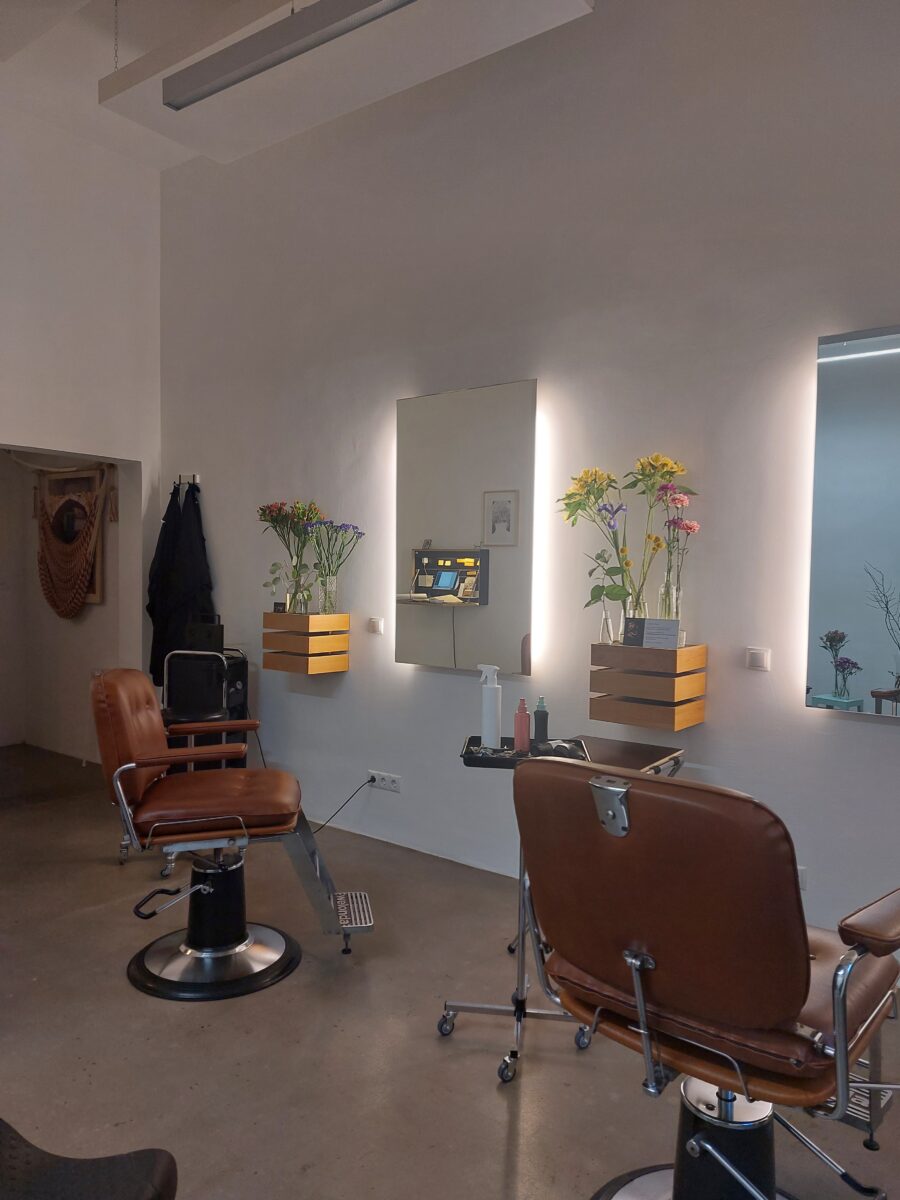


After years of renovations and extensive efforts to crowdfund and finance both the purchase and restoration, fux eG is now home to around 200 people working in various fields, including art, crafts, design, adult education, political organising, food, film, hairdressing, photography, and more. It also serves as a meeting place for the local community and a venue for cultural events, music, and activities. fux eG is fully self-managed and self-organised, with the building divided into ”quarters”, each of which is independently managed. Some of you might remember that Backa Kåken takes much inspiration from their model and fux representatives have been in Malmö to share their story.
Fux had some internal conflicts in the beginning, also because they were two quite different groups coming together: an association of artists that were already in the building and were granted interim use with very low rents and a group of right to the city and cooperative activists, that wanted to co-own and manage the building to secure the use and affordability in the long-term. They had to learn how to work together and negotiate sometimes quite diverse needs, capacities and ways of working.
Lessons in organising from fux eG
- Really important to remove the property from the market to ensure long-term access and affordability.
- Clarity of shared purpose, vision and values is really important. Might need to be negotiated again when new people join.
- Create smaller working units with clear mandates.
- Break down the big job into many small steps. Accept limitations and prioritise.
- Rules are important and they work!
- In time-sensitive processes like securing the ownership of a building (dependent on external conditions), there is always a tension between urgency and sensitivity to power in the group.
- In the development time, they had regular assemblies of everyone who wanted to take part.
- People’s contributions look very different. Not everyone can (all the time). 1-1 conversations are really important.
- Don’t focus on the people who are uninterested or angry. Focus on the ones that are present and helpful.
- Being on the board is a tough role, especially when things get difficult. Be clear on their mandate from the beginning; they are the rule protector and the no-sayer. Treat them kindly.
- They gave a clear mandate to a smaller group for negotiations with the city and banks.
- Volunteers can’t do everything, some work must be paid – they started by paying for administrative work and finance development, later project management for the build. They wish they had also paid someone to support self-organisation and inclusion from the beginning!
- They had a working group from the beginning that helped with internal moderation and facilitation of meetings, conflict resolution, etc.
- They now also have a working group that deals specifically with setting rent prices fairly.
- What helped them over the years to stay connected and motivated are storytelling formats, such as an internal radio, a zine and video portraits to learn about who is in the building, as well as informal meetings over food, a travelling house bar and of course the ‘heart of the house’ which is the canteen!
6:00 PM
Dinner was prepared by fux populi, a youth-led initiative running a monthly pay-what-you-can community kitchen in the canteen (more about them see in blog 1 and blog 2).


8:00 PM


The day ended with a DJ workshop with DJ Tutku and dance session led by Gr8t Ones in the basement club Slot – a joyful finale!
Monday, October 6th 10:00 AM
Last morning. Last workshop. We held a “four-finger feedback” session: What was great? What will I take with me? What was too short? What’s next?
Some reflections & feedback
- Great mix of different organisations. Inspired by how other organisations organise themselves.
- It feels important that more young voices are included in the decision making.
- Strong impressions from Hallo e.V. and their handling of oppressive history.
- Enjoyed doing things together, like cooking, training, dancing, spraying.
- Want to learn more from each other’s experience and knowledge.
- Go deeper into the “how”, share methods.
- Wanting more time to discuss power structures and particularly to learn more hands-on tools for decision-making and conflict resolution.
- Curious about Kinderstadt, a format that Dock does every two years where 300 children self-organise a space together for a week.
- Want to do this again, but with more people, we all have partners across Europe, let’s bring them together.
- Let’s create something together next time, an event or a festival. It’s about doing things together!

We work with different time scales. In five years the kids will be grown, we don’t have time to talk or analyse too much. Think one or two years ahead and do things now!
Bulltofta IF
12:00 PM
We checked out and thanked Dock Europe for their warm hospitality. After a bit of sightseeing (and shopping!), lunch, a cancelled train and a very long journey, we finally got home nearly 12 hrs later… Tired and happy!


Funded by the European Union. Views and opinions expressed are however those of the authors only and do not necessarily reflect those of the European Union. Neither the European Union nor the granting authority can be held responsible for them.